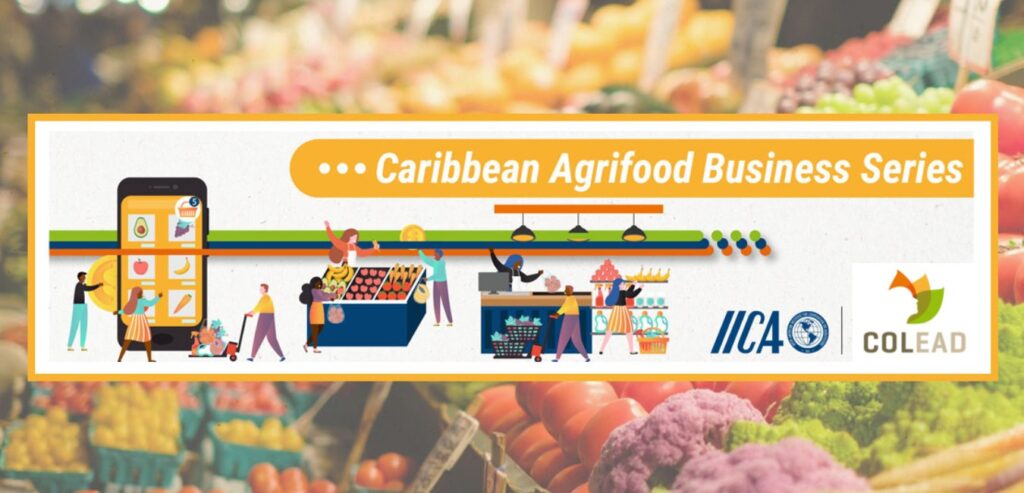

CARIBBEAN AGRIFOOD
BUSINESS SERIES

Caribbean Agrifood Business Series: What is it?

As part of the post-COVID-19 recovery process, IICA and COLEACP join forces, in collaboration with other international and Caribbean partners, to support a more resilient and greener agricultural and agrifood business sector in the Caribbean. A two-hour bimonthly session focusing on entrepreneurship development will be organized. This Caribbean Agrifood Business Series aims at: (i) Exchanging ideas and best practices on selected priority issues; (ii) Showcasing successes of smallholders, businesses and micro, small and mediumsized enterprises (MSMEs); (iii) Promoting and documenting forthcoming innovations and technologies benefiting smallholders and MSMEs; (iv) Promoting networking amongst various stakeholders in the food chain; (v) Disseminating research findings.

Topics will range from improved production, trade and competitiveness, food safety and quality, rebuilding tourism with increased linkages to agriculture, bioeconomy and green businesses to regional logistics and efficiency in trade. Each session will feature businesses and MSMEs across the region, especially targeting local and regional markets, and will bring views from experts in finance, technology, policy, research.

Events organized in the Framework of Development Cooperation between the Organisation of Africa, Caribbean and Pacific States (OACPS) and the European Union.

In collaboration with:

EULOGO
ACPLOGO

News

IICA COLEAD NEXT WEBINAR : Opportunities in local and regional markets for Caribbean entrepreneurs The Read more

Upcoming event

[coleacp-events categories=”iica” dates=”coming”]

Past events

[coleacp-events categories=”iica” show=”3″]

On 23 November 2022, during the 7th Caribbean Agrifood Business Session organised by IICA and COLEACP, several Caribbean companies shared their journey to successfully entering lucrative markets. The online session was attended by over 180 participants from the Caribbean region, Africa and Europe (agenda of the session; spearkers’ biodata). The recording of the session is available on COLEACP’s YouTube channel. Norman McDonald presented the Jamaican company Canco Ltd. and its brand, Linstead Market, of high-quality products such as canned ackees,… +
Over the past decades, agriculture has continuously expanded and enhanced its productivity to ensure food security and food safety to the growing global population in an unsustainable way. This has led to the loss of natural ecosystems, declining biodiversity and increasing greenhouse gas emissions1. The global agrifood system, which includes food production, processing, packaging and transport, is responsible for one of the largest shares of greenhouse gas emissions2 and thus is an important contributor to climate change. However, promoting more… +
This series of events focuses on innovations and successes of Caribbean farmer-led businesses and SMEs. The events are organised by the Inter-American Institute for Cooperation on Agriculture (IICA) and COLEACP. Sustainable agriculture, good practices, bioeconomy, trade, food safety and quality, resilience, and the link between agriculture and tourism are some of the key focus areas for collaborative efforts. The sixth session, held on 25 August 2022, focused on the “High-end market opportunities for Caribbean agrifood products”. To compete globally, it… +
The World Food Day 2022 highlights the increasing interlinkages of economies, cultures, and populations with its theme “leave no one behind”. Global health, planet and political challenges call for global solutions that include guaranteeing the access and availability of nutritious food, as well as reducing food losses and waste. These solutions should specifically be designed and adapted to rural populations as they are the most vulnerable to food and climate crises, with 80 % of the extreme poor living in… +
The 2022 International Day of Awareness of Food Loss and Waste (#IDAFLW) is a call for all to pursue the efforts in meeting the target 12.3 of the Sustainable Development Goals (SDGs) for halving per-capita global food waste at the retail and consumer levels and reducing food losses along production and supply chains by 2030. 17% of the total food produced is wasted at the retail, food service and consumption levels.1 In addition, 14% the world’s food production for human… +
The young people of today and tomorrow play a central role in transforming food systems to provide access to sufficient and nutritious food, and adopt sustainable approaches to address climatic and environmental challenges. There are 1.2 billion young people between the ages of 15 and 24 worldwide (16% of the global population), of whom nearly 1 billion world resides in developing countries. Their numbers are growing far more rapidly than in higher-income countries.1 60% of Africa’s 1,2 billion population are… +
With respectively less than 10, 50 and 250 employees, Micro, Small and Medium-sized Enterprises (MSMEs) are the backbone of most economies. They account worldwide for over 70% of all businesses and for more than 50% of jobs,1 especially for women and youth. MSMEs work with millions of family farms and contribute to securing food safety and security, providing nutrition to local consumers and communities, as well as promoting innovation and creativity towards sustainable food systems. MSMEs are highly sensitive to… +
Within their collaboration to develop a more sustainable and resilient agriculture sector in the Caribbean region, the Inter-American Institute for Cooperation on Agriculture (IICA) and COLEACP launched in June 2021 the Caribbean Agrifood Business Series aimed at showcasing innovations and successes of Caribbean farmer-led businesses and SMEs. 5 sessions have been held gathering more than 1,200 participants from more than 70 countries on different continents. The sessions are available for viewing in English, French and Spanish on COLEACP’s YouTube channel.… +
Two recent webinars focused on agrifood businesses in the Caribbean and Africa: “Agriculture trade: Opportunities for SMEs and businesses in export markets” (with the Inter-American Institute for Cooperation on Agriculture, IICA); and “Catalysing young African agri-entrepreneurs’ investments” (with the Pan-African Farmers’ Organization, PAFO). Agriculture trade: Opportunities for SMEs and businesses in export markets IICA-COLEACP Caribbean Agrifood Business Series: Session No. 5 This series focuses on innovations and successes of Caribbean farmer-led businesses and SMEs. The 31 March session highlighted the… +
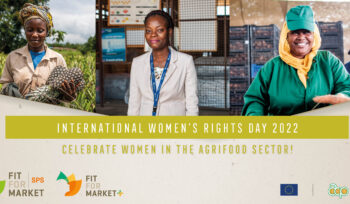
Celebrate women in the agrifood sector! Worldwide, about a third of established businesses are women owned and managed.1 Sub-Saharan Africa has of the highest rates of women’s entrepreneurs.2 Latin America and the Caribbean region show a high rate of women entrepreneurs involved in high-growth activity and manufacturing and transportation sector, half of them being under the age of 35.3 Women are a significant entrepreneurial force as owners of farms, input supply stores, service delivery businesses, and processing and export firms… +