

- 22/12/2025
- Posted by: Sandra Borma
- Category: News
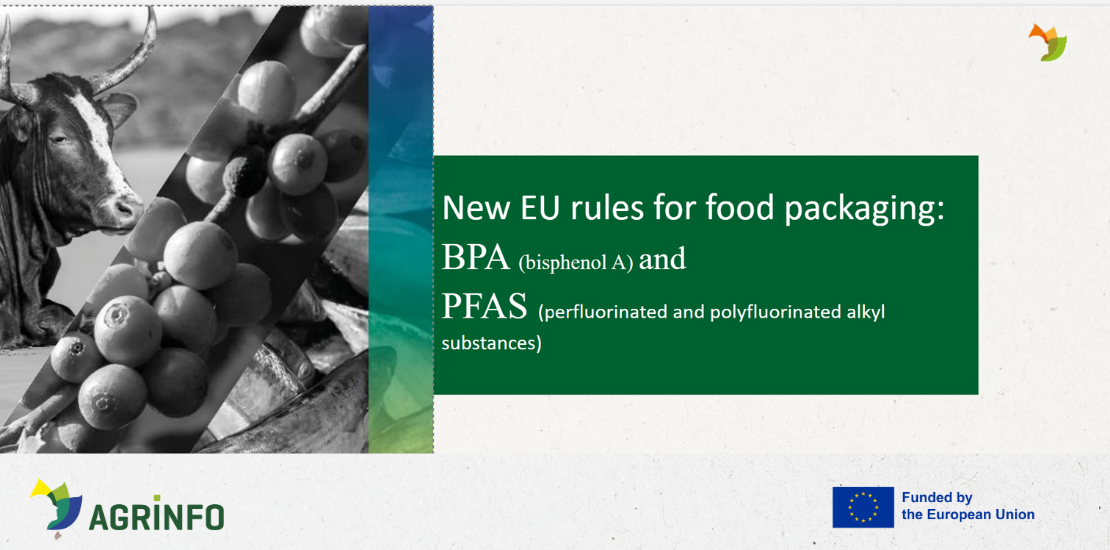
The AGRINFO programme recently organised a series of webinars to raise awareness of changes to European Union (EU) rules on Bisphenol A (BPA), other bisphenols and bisphenol derivatives, as well as per- and polyfluorinated alkyl substances (PFAS) in food packaging. The webinars focused on the practical implications of these new rules for businesses and institutions in AGRINFO partner countries whose packaged products – when exported to the EU – need to comply with the EU legislation, including on food contact material.
The EU has adopted Regulation (EU) 2024/3190, introducing stricter rules on the use of BPA and related substances in food contact materials and articles. These requirements will apply from July 2026, with a later deadline of January 2028 for packaging intended to preserve fruit, vegetables and fishery products. In parallel, the new Packaging and Packaging Waste Regulation (EU) 2025/40 sets limits on PFAS in food contact packaging, applicable from August 2026. Compliance with both regulations must be demonstrated through a written Declaration of Conformity.
To explain these changes, AGRINFO held three 90-minute online sessions on 25 November, 3 December and 4 December 2025, allowing participation across different time zones. Each webinar covered the same content and included simultaneous interpretation into French, Spanish and Portuguese for selected sessions. The programme combined an introduction to AGRINFO and EU food contact material legislation with a detailed presentation by an external expert.
The initiative attracted strong interest, with 927 registrations and 518 participants, representing an attendance rate of 56%. Presentation slides and video recordings are available online in multiple languages, and a consolidated FAQ document based on participants’ questions is currently being prepared and will be shared shortly.
This activity is supported by the AGRINFO programme, implemented by COLEAD and funded by the European Union (EU). This publication receives financial support from the European Union. The content of this publication is the sole responsibility of COLEAD and can in no way be taken to reflect the views of the European Union.