

- 08/06/2026
- Posted by: Sandra Borma
- Category: News
In brief
- Through the Fit For Market Plus (FFM+) programme, COLEAD carried out an energy efficiency audit and a renewable energy management plan at Broomrigg Farm (Zimbabwe).
- The horticultural business faces rising energy costs, grid instability and recurrent load shedding.
- Irrigation and cold chain operations stand out as the largest energy consumers.
- A phased roadmap is proposed, built around a 150 kVA hybrid solar PV system.
- Estimated gains: around 75,000 kWh saved per year (about 54% less consumption), roughly USD 11,250 in annual savings and approximately 75.8 tonnes of CO₂ equivalent avoided each year.
An energy system under strain
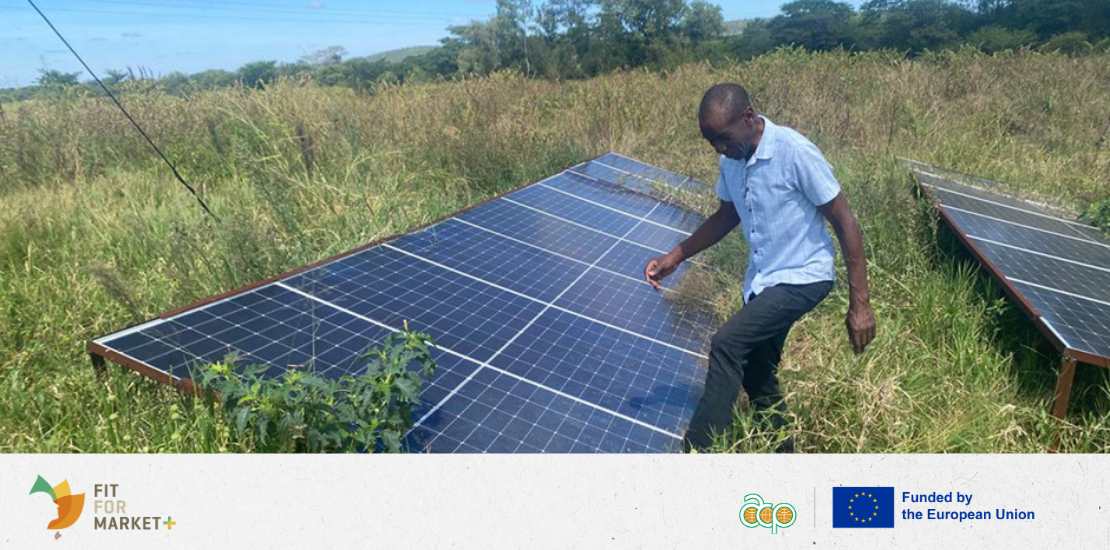
Broomrigg Farm operates within Zimbabwe’s horticultural sector, where rising energy costs, grid instability and recurrent load shedding pose major operational challenges for agri-food businesses. Reliable energy is especially critical for irrigation, cold chain operations and future pack house development. The farm has already taken an important step by solarising four boreholes that support irrigation, and is now planning a new pack house and cold rooms with renewable solutions integrated from the design stage.
A hands-on technical mission
The mission combined physical inspections of infrastructure and energy systems, a review of consumption records, technical assessments of irrigation, boreholes and cold chain, and consultations with the management and technical teams. The aim was a detailed audit, identification of the main inefficiencies, and an energy management plan aligned with operational realities and expansion plans.
What the audit revealed
Irrigation pumping and cold chain operations emerged as the largest energy consumers, particularly in winter. Several efficiency measures were identified: variable frequency drives (VFDs) on irrigation pumps, improved cold room insulation and refrigeration, upgrading of non-standard wiring, LED retrofits, load shifting and staggered pumping, and stronger monitoring and maintenance. Technical recommendations were also developed for the future pack house (sizing, insulation, energy-efficient cooling, solar PV integration), alongside a phased roadmap centred on a 150 kVA hybrid solar PV system.
What comes next
The next phase will focus on gradual implementation: solarising the remaining boreholes, building energy-efficient cold rooms and pack house infrastructure, installing VFDs and upgraded electrical systems, introducing performance monitoring, and expanding solar PV capacity. By combining energy efficiency with renewable investment, the farm can lower costs, improve energy reliability and strengthen climate resilience.
This activity is supported by the Fit For Market Plus (FFM+) programme, implemented by COLEAD within the Framework of Development Cooperation between the Organisation of African, Caribbean and Pacific States (OACPS) and the European Union. This publication receives financial support from the European Union and the OACPS. The content of this publication is the sole responsibility of COLEAD and can in no way be taken to reflect the views of the European Union or the OACPS.