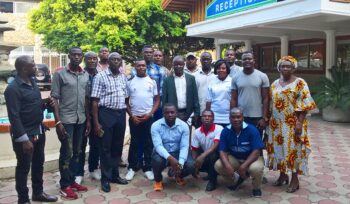
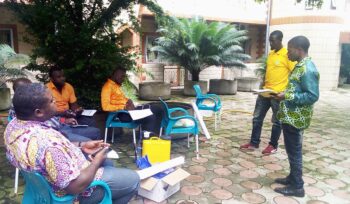
Technical assistance in setting up a compost unit, organised for the company AfricaBio in Cameroon, illustrates a key aspect of COLEACP’s waste-management intervention strategy.
The intervention strategy is based on two complementary axes – reduce the amount of waste produced
recover residual waste. It aims to meet growing demand from partner horticultural companies for the management and recovery of processing waste, and also to reduce losses, particularly in post-harvest situations.
AfricaBio in Cameroon produces and processes various fruits from organic… +
We organized a 2-day workshop in Nigeria ????????️ focusing on “The role of Public and Private sectors in sanitary and photosanitary control systems for the Fruits and Vegetable sub-sectors.” More than fifty people from the Public and Private sectors attended this awareness raising Workshop.… +
We organized in collaboration with the Agricultural Fresh Produce Growers & Exporters Association of Nigeria an awareness raising workshop on the upcoming changes in the EU Plant Health Regulation in Abuja (????????️). You can find more information about this regulation on our website at : https://www.coleacp.org/…/new-eu-plant-health-regulation-an…
Participants included public sector actors as the Plant Quarantine Department (NAQS), the Federal Ministry of Industry, Trade and Investment, National Technical Working Groups as well as representatives of the European Delegation, ECOWAS Commission –… +
The Cool Channel Association CCA is a non-profit organization, founded in 2003, with the aim to reduce wastage and improve the quality, efficiency and value of the temperature sensitive supply chain by facilitating and enabling vertical & horizontal collaboration, education and innovation.
The CCA organizes 2 high level panels per year. The event in June focuses on perishable products. The topic in 2018 was “World Without Food Waste – what can air cargo deliver ?”.
On 19 June, Jeremy Knops,… +
For its twelfth edition, the European Development Days (EDD) 2018 aims at bringing together the European Union’s commitment to gender equality and women’s empowerment with the 2030 Agenda for Sustainable Development. On June 5 and 6 in Brussels, the event will focus on the vital role of women and the need for their full and equal participation and leadership in achieving the Sustainable Development Goals.
In full resonance with this commitment, COLEACP will be present in the EDD village (booth… +
On 12th April, the European Commission proposed new legislation on unfair trading practices (UTPs). This is a very positive development and will offer more protection to farmers and small operators in the food industry who are selling to large European buyers. Most importantly, the legislation covers not only European suppliers, but also those selling into the EU from third countries.
Up to now, ACP fresh produce exporters supplying European supermarkets have been at risk to UTPs such as late payments,… +
COLEACP and the European Development Fund National Authorizing Officer Support Unit (CAON-FED) signed a partnership agreement on 22 March to share their knowledge and experience with a view to heightening capacity building in the public and private horticultural sector in Cameroon.
The principle objectives of this partnership are to: Promote the horticultural sector as a driver for macro-economic growth through job creation for the younger generation by ensuring that agriculture is more productive, competitive and relevant to national, regional and … +
“Women and girls at the forefront of sustainable development: protect, empower, invest” will be the key theme of these 2018 European Development Days (EDD). COLEACP will be one of the exhibitors at the EDD development village in partnership with the ACP YPN.
Our new training system will be showcased, together with a concept store, linked to an online shop, that will present innovative, healthy and high-quality products (organic fruit juices, dried mangos and pineapples, coco butter, mango butter,…) and more… +
How can you ensure a successful trade fair participation at the next edition of Fruit Logistica in 2019?
By preparing your participation! COLEACP has drawn up a practical guide for its members that can be obtained by clicking here.
From this year onwards, Africa has a dedicated exhibition hall. The success of this new exhibition centre has created a very favourable environment for mobilising new country exhibitors in 2019. Do you already have a project in mind? We can help… +
To date, over 350 individual requests for support have been sent to COLEACP from 30 countries in Africa, the Caribbean and the Pacific (ACP) as part of the Fit For Market (FFM) programme (see the map below).
140 of these applications have already been converted into action plans which are being implemented on the ground to help strengthen the competitiveness and further the sustainability of the fruit and vegetable industry in ACP countries.
20 SMEs have specifically requested support to… +
“Re-envisioning Investment for African agriculture…” Lecture by Agnès Kalibata, on Friday 23 March in Gembloux, Belgium.
Next Friday 23 March 2018, Agnès Kalibata, President of AGRA (Alliance for a Green Revolution in Africa) is set to deliver a lecture at Gembloux Agro-Bio Tech – Liège University, entitled “Re-envisioning Investment for African Agriculture: Top Priorities for Growing Food, Jobs and Economies”.
In her capacity as the President of AGRA and in partnership with the public and private sector, Doctor Agnès Kalibata… +
Learn, test and certify your know-how in the following 7 key areas for a sustainable and inclusive agricultural industry:
– Food safety
– Plant health
– Social accountability and empowerment
– Agricultural production and processing
– Sustainable production and trade
– Business management and development
– Environmental management
All these interactive learning journeys are differentiated according to the degree of expertise and level of progress.
Visit our Platform!… +
En Guinée, nous avons rencontré le Ministre du Commerce M. Marc Yombouno ainsi que la Ministre de l’Agriculture Mme Mariame Camara en présence du Bureau d’Exécution Stratégique. Nous avons discuté notamment de notre partenariat sur le programme PRODEFIMA dont le but est de contribuer à l’accroissement des revenus des acteurs de la filière mangue, en particulier des petits producteurs.
Nous sommes ensuite allés à la rencontre de la Compagnie Fruitière de Daboya exportatrice de mangues et productrice de fruits de… +
The COLEACP team will be present at Fruit Logistica in Berlin from 7 to 9 February. We will be located at Hall 26 / Stand D-17.
For ACP and European companies that will not be attending the exhibition, we are of course at your disposal if you need any information or have particular issues to discuss. In particular, we are available to provide information about the mechanisms for accessing and implementation of FFM. Please note that applications for FFM support… +
Post date: January 28th, 2019 As you know, COLEACP will have a booth (Hall 26 Booth D-17) at the upcoming Fruit Logistica exhibition, to be held in Berlin from 6 to 8 February. You are of course welcome.
More than 3,200 exhibitors and 78,000 trade visitors will participate in FRUIT LOGISTICA 2019. The Africa Hall, successfully launched in 2018, will again be host to COLEACP in 2019.
FRUIT LOGISTICA 2019 offers an opportunity for SMEs from ACP countries, visitors and… +
The Fit For Market (FFM) programme was launched officially in December 2016 and in just one year has received 300 requests for support from thirty African, Caribbean and Pacific countries (see map below).
The largest number of requests (167 out of 300) come from horticultural micro, small, and medium enterprises (142 requests) and producer farmer groups/cooperatives (25).
Support services have sent 124 requests, mainly consultants and consultancy companies (51). Other requests come from : Farmer and professional organisations/associations (37), Smallholders… +
Khadija Niang embodies the future of Africa, the hope of better days for young people from modest but virtuous backgrounds. At the same time she represents all the difficulties faced by this generation from which the leaders of tomorrow must emerge, the executives who must make the African bet work; feed Africa and turn it into one of the biggest agro – industrial forces. To move beyond religious socio-cultural fatalism, by breaking the traditional codes.
The only one of a… +
COLEACP has started the journey towards Abidjan AU-EU summit next week. Yesterday, amongst a sea of promises, political speeches, COLEACP brought a fresh and new voice of reality from Africa’s youth into the heart of the European Parliament to the “High level conference towards a renewed partnership for Africa”.
Ms Khadija Niang, “spokesperson” for the young Africans working in agriculture, told her story, shared her struggle for recognised qualifications and training so that she may secure a successful career in… +
Although it is established that the poor countries of the South are and will be the first victims of global warming, and that the most polluting country has stated its intention to withdraw from the Paris Agreement, managing agricultural production on all fronts has become the sine qua non to guarantee access to the most profitable markets.
Since 2000, COLEACP has drawn up strategies aimed at updating the knowledge of its members and beneficiaries: a multitude of SMEs, small-scale producers… +
Until the new European Plant Health Regulation comes into force in December 2019, the application of existing EU rules is being reinforced. This has implications for third countries exporting to the EU, including the African, Caribbean and Pacific (ACP) states.
On 15 July 2017, the European Commission published Implementing Directive 2017/1279, which sets out important new plant health rules affecting ACP exports. These rules require additional measures for the control of four new quarantine pests, including False Codling Moth (Thaumatotybia… +
On 13 December 2016, the new EU Plant Health Regulation (Regulation (EU) 2016/2031) was introduced*. This is a major overhaul of the EU Plant Health legislation, which has been in place since 1977. It repeals and replaces the 7 existing Council Directives on harmful organisms, and becomes fully applicable on 13 December 2019. In the interim, a series of delegated and implementing acts will be adopted, and competent authorities and operators must adjust to the new rules.
One of the… +
COLEACP follows sanitary and phytosanitary regulations (SPS) very closely to identify the decisions and trends which could have an impact on the fruit and vegetable value chains in Africa, the Caribbean and the Pacific. The information obtained is used to adapt the technical recommendations for producers and inform the ACP suppliers about the measures to be taken.
COLEACP tracks the following issues on a monthly basis in particular: MRL exceedances (maximum residue limits) for pesticides on fruit and vegetables arriving… +
With new training topics, new online and paper tools, COLEACP’S training department is expanding its offer to meet the needs of companies benefiting from the Fit For Market* (FFM) programme.
One of the central pillars of the FFM programme is the COLEACP training system.
Designed and implemented during the PIP programmes and later expanded to other projects coordinated by COLEACP (e.g. EDES, Fruit Fly Programme), the programme now offers new teaching resources. Around 100 new training tools (manuals, guides, brochures… +
The banana is the world’s most exported fruit (around 10 billion US dollars per year). It is an essential source of income and employment for thousands of rural families in developing countries, including African and Caribbean countries*. Since it was established in 1973, COLEACP’s members have included key players from the global banana supply chain. In joining the World Banana Forum (WBF), the association reaffirms its commitment to increasing its activities in this sector which is of high socioeconomic importance… +